


Key takeaways:
- Goods in transit insurance covers loss or damage to goods while they’re being transported, including theft, collisions, fire and loading incidents.
- Couriers can be personally liable for damaged or stolen goods while they are in their care.
- The policy covers physical damage to freight, but usually not indirect financial losses like lost income or project delays.
- Your limit of liability must reflect the highest value you carry at any one time, not your average load.
- Many courier contracts and logistics providers require proof of goods in transit cover before work can begin.
- Goods in transit insurance should be structured around how you operate, including your routes, storage practices and the type of goods you transport.
If you’re a courier, transport operator or owner-driver, you’re responsible for more than just getting parcels from A to B. You’re responsible for the value of the goods inside your vehicle.
When something goes wrong, many operators find themselves asking the same question: What does goods in transit insurance actually cover?
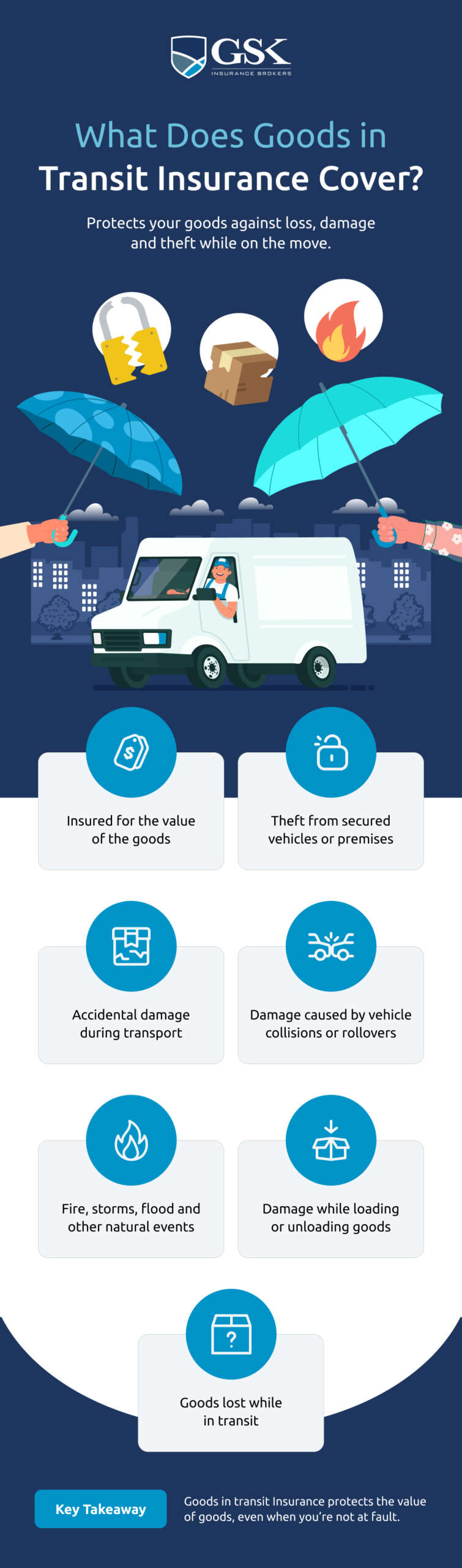
In simple terms, it covers loss or damage to the goods you’re transporting, whether that’s caused by a vehicle accident, theft, fire, storm damage or accidental mishandling during loading and unloading.
For many Australian couriers, this cover isn’t optional. It’s often required under contract and plays a key role in protecting your income and business stability.
Understanding exactly where the protection starts and where it stops can make a significant difference when something goes wrong. So let’s break down everything you need to know about transit insurance cover.
Why goods in transit insurance matters for Australian couriers
Courier and delivery demand continues to grow across metro and regional Australia. With more parcels moving daily, the financial risk attached to each delivery increases. This is especially true for owner-drivers and small transport operators who are legally responsible for the goods they carry.
Every delivery represents financial responsibility. If you’re transporting $20,000 worth of electronics, medical supplies or specialised equipment and something goes wrong—theft or accidental damage, for example—you may be required to compensate the client. And for many couriers, that cost comes directly out of their pocket.
Goods in transit insurance exists to protect you from that financial shock. It helps safeguard:
- Your cash flow: Avoid paying for damaged or stolen goods yourself.
- Your business reputation: Resolve incidents professionally without damaging client trust.
- Your contractual compliance: Many logistics providers require proof of cargo cover.
- Your ability to secure future work: Larger clients often won’t engage uninsured carriers.
In short, goods in transit insurance matters for Australian couriers because it protects you from being personally liable for damaged or stolen goods, and it safeguards the financial stability of your business.
What does goods in transit insurance typically cover?
Cover can vary between insurers, but most goods in transit policies in Australia usually protect you against the following risks:
Vehicle collision or overturning
If your delivery vehicle is involved in an accident, the goods you’re carrying may be covered for damage or total loss.
This includes incidents such as:
- Rear-end collisions.
- Multi-vehicle crashes.
- Vehicle rollover.
- Impact with a stationary object (such as a pole or barrier).
Even low-speed accidents in metro traffic can result in thousands of dollars’ worth of damaged freight, particularly if you’re transporting fragile or high-value items.
Theft and forced entry
Theft is one of the most common goods in transit claims in Australia. Cover generally applies when:
- The vehicle is locked.
- There are signs of forced entry.
- Security conditions in the policy are met.
Here’s an example:
A courier parks overnight in a secure Perth industrial area. Thieves force entry into the locked van and steal electronics worth $25,000.
If the van was locked and all security conditions were met, the insurer would usually cover the loss. However, if it was left unlocked or parked in breach of policy conditions, the claim could be declined.
Accidental damage during transit
Not all damage is caused by major accidents. Goods can also be damaged during normal driving conditions. This may include damage caused by:
- Sudden or harsh braking.
- Load movement inside the vehicle.
- Rough or uneven road surfaces.
- Minor traffic incidents.
For example: If traffic stops suddenly and unsecured cartons shift forward, fragile items may be crushed or broken.
Most goods in transit policies cover this type of accidental damage. That is, as long as the goods were properly secured and you took reasonable steps to transport them safely.
Loading and unloading damage
Not all damage happens on the road. In fact, many goods in transit claims occur while items are being loaded onto or unloaded from the vehicle.
This can include damage caused by:
- Forklift punctures through cartons or pallets.
- Dropped boxes during manual handling.
- Mishandled or improperly stacked freight.
- Damage while transferring goods between vehicles.
Consider this example:
A pallet of boxed electronics is accidentally pierced by forklift tines while being loaded onto a delivery vehicle. Even though the vehicle hasn’t left the warehouse, the goods have already been damaged.
Most goods in transit policies cover loading and unloading incidents like this, provided the goods were being handled as part of normal business operations and reasonable care was taken.
This type of cover is particularly important for couriers transporting fragile, high-value, or palletised goods.
Fire and natural events
Some losses have nothing to do with driver error or traffic incidents. They’re caused by unexpected events outside your control.
Depending on your policy, goods in transit insurance may cover loss caused by:
- Vehicle fire.
- Severe storms or hail.
- Lightning strikes.
- Flooding (if flood cover is included).
How are goods valued under the policy?
Goods in transit insurance usually covers the value of the goods being transported. How that value is calculated depends on the situation.
In most cases:
- If the goods have recently been bought or sold, the insured value is the invoice or sale price.
- If there hasn’t been a recent sale, the goods are insured based on their current market value.
- Some policies require you to declare a maximum value per load, which becomes the limit of what the insurer will pay for a single claim.
This is known as the limit of liability. It’s the maximum amount your insurer will pay for one load of goods.
It’s important to choose a limit that reflects the highest value you carry at any one time. For example:
- A small parcel courier might carry $10,000–$20,000 worth of goods in a single run.
- A courier transporting electronics or medical supplies could be carrying $50,000–$100,000 or more.
If your cover limit is lower than the value of the goods you’re transporting, you may have to pay the difference yourself if something goes wrong.
What doesn’t goods in transit insurance usually cover?
While goods in transit insurance provides valuable protection, it does not cover every possible situation. Being aware of exclusions helps you assess whether your cover matches your actual business risks.
Common exclusions include:
- Consequential loss: The policy usually covers the cost of repairing or replacing the damaged goods. However, it does not usually cover the knock-on financial losses that happen because those goods were damaged, such as lost income, cancelled contracts or project delays.
- Deliberate acts or collusion: If you, your employee, or anyone responsible for transporting the goods is involved in stealing them—or helping someone else steal them—the claim will be denied.
- Failure to take reasonable care: Insurance expects you to take sensible precautions. If goods were left unsecured, poorly packed or the vehicle was left unlocked, the insurer may decline the claim.
- Certain high-risk goods: Some types of cargo are considered higher risk and are often excluded from standard goods in transit policies unless specifically agreed in writing. These may include:
- Cash
- Precious metals
- Jewellery
- Tobacco products
- Explosives
- Livestock
- Bulk fuel
Do I need goods in transit insurance in Australia?
Goods in transit insurance is not legally mandatory under Australian law. However, for many courier and delivery operators, it becomes essential in practice.
You are likely to need it if you:
- Work as a subcontractor for a larger transport company.
- Deliver for major logistics providers or courier platforms.
- Transport high-value goods.
- Enter into contracts that require proof of cargo insurance.
Most logistics companies and courier platforms will ask for a certificate of currency before approving you to carry freight on their behalf. If you cannot provide evidence of goods in transit cover, you may not be able to secure the work.
How goods in transit insurance works with other courier cover
Goods in transit insurance protects the cargo you’re carrying, but it doesn’t cover every risk your courier business faces. That’s why it usually sits alongside other types of business insurance.
A well-structured courier insurance package may include:
- Commercial motor vehicle insurance: Covers your work vehicle if it’s damaged in an accident, stolen or written off.
- Public liability insurance: Covers claims if a third party is injured or their property is damaged during your work.
- Income protection insurance: Provides financial support if you’re unable to work due to injury or illness.
Each policy responds to a different type of risk. For example:
- Your van is damaged in a crash → commercial motor vehicle insurance applies.
- The customer’s goods are damaged in that crash → goods in transit insurance applies.
- A pedestrian is injured during the incident → public liability insurance may apply.
Together, these policies create layered protection for your vehicle, your cargo, and your income.
How to choose the right goods in transit policy
Before selecting a policy, consider the key risks in your operation.
The type of goods you carry
Different goods carry different levels of risk. For example, do you transport:
- Fragile electronics?
- Medical supplies?
- Bulk general freight?
- Perishable goods requiring temperature control?
The higher the value or sensitivity of the goods, the more carefully your cover needs to be structured.
Where and how you operate
Your delivery routes also affect your risk exposure.
- Metro couriers typically face heavier traffic and higher theft risk.
- Regional operators may deal with longer distances, wildlife collisions, and severe weather.
Your policy should reflect the environment you’re working in.
Policy limits and excess
Finally, review the financial details of the policy:
- Make sure your limit of liability covers the highest value you carry at one time.
- Choose an excess you can realistically afford if you need to make a claim.
- Confirm that security and storage conditions match how you actually operate.
Choosing a cover based only on the lowest premium can leave costly gaps later.
Make sure your goods in transit cover matches how you actually operate
Goods in transit insurance is only effective when it matches how you actually work, including the goods you transport, where your vehicle is stored, the contracts you operate under, and your delivery routes.
At GSK Insurance Brokers, we work with couriers, owner-drivers, and transport operators across Australia to structure goods in transit cover that aligns with real operational risks.
We’ll review your current limits, security conditions, and contract requirements to ensure there are no costly gaps hiding in your policy.
Talk to a GSK broker today to arrange goods in transit insurance that protects your cargo, your contracts, and your income.
Frequently asked questions
Does goods in transit insurance cover subcontracted drivers?
If you use subcontractors or additional drivers, cover does not automatically extend to them under every policy. Some insurers require all drivers to be declared, and certain subcontracting arrangements must be disclosed.
If subcontractors are transporting goods on your behalf, you should confirm whether your policy covers them or whether they need their own goods in transit insurance.
Does goods in transit insurance cover goods while temporarily stored?
Goods in transit insurance generally applies while goods are being transported. Temporary storage, such as holding freight in a depot or warehouse for several days, may not be covered unless specifically included.
If your operations involve storage between delivery stages, you may need separate warehouse or storage cover.
How quickly should I report a goods in transit claim?
Most insurers require claims to be reported as soon as reasonably possible after an incident occurs. Delays in reporting, incomplete documentation, or failure to provide evidence (such as photos or police reports for theft) can complicate or delay the claims process.
Prompt reporting helps protect your position and speeds up assessment.
Does goods in transit insurance cover interstate deliveries?
Many policies cover deliveries within Australia, including interstate transport. But geographic limits must be clearly stated in the policy schedule.
If you expand from local metro deliveries to interstate freight runs, your insurer should be notified to ensure your cover remains valid.